





Data science is an emerging technology in the corporate society and it mainly deals with the data. Applying statistical analysis to data and getting insights from it is our main objective. A company wil store millions of records for analysis. A data scientist will collect all the required data and conduct statistical operations to arrive at conclusions. This type of statistical analysis is called Descriptive Statistics. Suppose they collect a subset of data, known as Sample in statistical terminology, from the entire data known as Population. The sample is analyzed and conclusions are drawn about the population. This type of analysis falls under Statistical Inference (also known as Inferential Statistics).
In this article, I will explain some Statistical Inference concepts using Python Programming.
Context
1. Sampling Methods
2. Hypothesis Testing
1. Sampling Methods
Why this Sampling is necessary for Statistical Analysis? Because to reduce the
maximum permissible error, confidence level, and population variance/ standard deviation. maximum permissible error is defined as the difference between actual output and predicted output.
Confidence Level is defined as the probability that the value of a parameter falls within a specified range of values.
Population Variance is defined as the value of variance that is calculated from population data.
The determination of sample size depends on three major factors, such as:
1. confidence level
2. maximum permissible error
3.population variance/standard deviation
The formula given below can be used to calculate sample size:
.png)
Where,
n = sample size
critical = critical Z statistic for the specified confidence level
σ = population standard deviation
E = maximum permissible error
The critical Z value for a specified confidence level is found in the Z table. Z table for various confidence levels is given below.
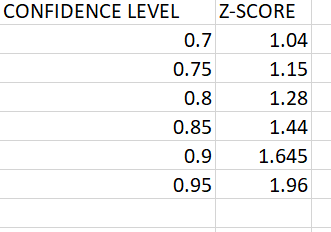
There are two types of sampling methods
1.1 Random Sampling
1.2. Stratified Sampling
Let’s take an example, Suppose 1000 students are present in a class and select 10 students with different characteristics(like marks, etc..) from them.
population=1000
sample =10
1.1. Random Sampling
If we use random sampling, It randomly selects the 10 students(sample) from 1000 students(population).
Drawback
By using Random Sampling, there is a chance to select the same type of students as a sample. It may give a biased result and such a sample is called a Biased Sample.
a=[]
for i in range(1,1001):
a.append(i)output:
array([715, 864, 18, 911, 309, 115, 598, 294, 651, 578])
To overcome this we can use Stratified Sampling.
1.2. Stratified Sampling
If we use Stratified Sampling, the population is divided into groups based on characteristics. these groups are called Strata.
The sample is chosen randomly from each of these groups.
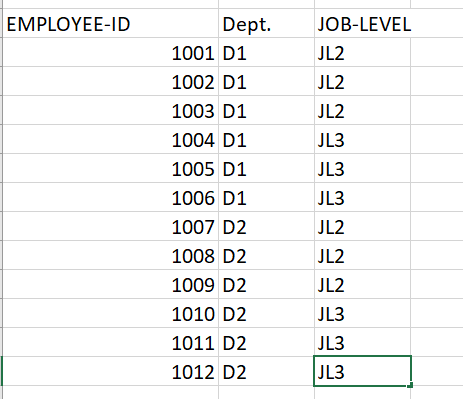
Suppose you have a list of 12 employees along with their department and job level information
You can sample the data by grouping it based on department and job level. There are two departments (D1 and D2) and two job levels (2 and 3).
#Taking a random sample from the population using the groupby function based on Department and Job Level
data.groupby(['Dept','Job_Level'], group_keys=False).apply(lambda x: x.sample(1))
output:
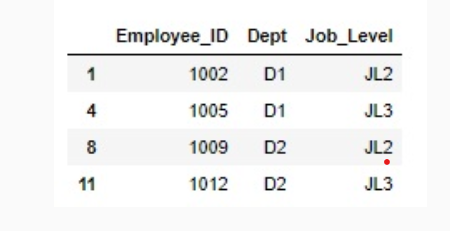
You can observe that the output sample has all combinations of ‘Dept’ and ‘Job_Level’.
The above output is the stratified sample.
2. Hypothesis Testing
Why hypothesis testing?
Let’s consider an example, The data scientist has successfully estimated the population means, population variance, and standard deviation using various point estimation techniques.
According to the data scientist, the confidence interval of the population mean is (408 to 417). The client wants to verify this claim.
Therefore, the client randomly chooses 100 students from the country and conducts the surprise test (consisting of the same questions) for them. The mean marks scored by those 100 students are found to be 403, which does not lie in the range specified by the data scientist.
Now the question arises, whether this observation is sufficient for the client to conclude that the estimation by the data scientist is not valid.
In inferential statistics, a Hypothesis Test is conducted to find answers to such questions.
What is hypothesis testing?
In statistics, the hypothesis is a statement about the population and it deals with collecting enough evidence about the hypothesis. Then, based on the evidence collected, the test either accepts or rejects the hypothesis about the population.
Hypothesis testing needs to be performed to find evidence in support of this hypothesis. Based on the evidence found, this hypothesis can be accepted or rejected.
In each hypothesis testing, there are two parameters Null hypothesis and Alternate hypothesis.
Null Hypothesis (H0): It is a statement that rejects the observation based on which the hypothesis is made. You can start the hypothesis testing considering the null hypothesis to be true. It cannot be rejected until there is evidence that suggests otherwise.
Alternate Hypothesis (Ha): It is a statement that is contradictory to the null hypothesis. If you find enough evidence to reject the null hypothesis, then the alternative hypothesis is accepted.
if the probability of occurrence of the given data is less than the level of significance (0.05) you can reject the null hypothesis.
if the probability of occurrence of the given data is greater than or equal to the level of significance (0.05) you cannot reject the null hypothesis.
steps to calculate the Hypothesis:-
Step 1: Let assume the null hypothesis, alternate hypothesis, and the level of significance.
Step 2: Calculate the P-value.
Step 3: Conclude whether to reject the null hypothesis or not based on the P-value i.e.
- If P-value < significance level, then reject the null hypothesis
- If P-value >= significance level, the null hypothesis cannot be rejected
Step 4: State the conclusion.
For the above example,
Step-1
Null hypothesis(H0): The estimate given by the data scientist is correct.
Alternate Hypothesis(Ha): The estimate given by the data scientist is incorrect.
Step-2
calculate P-Value:
#Importing the norm function from the scipy.stats module
from scipy.stats import norm
#Finding the probability of getting a value that is 0.56 standard deviation from mean using norm.cdf() function
print(norm.cdf(0.56))
output:- 0.712
Step-3
P-Value > level of significance.
So, it is failed to reject the null hypothesis.
Step-4
The estimate given by the data scientist is correct.
Conclusion
A statistical approach is the best to deal with data.


