



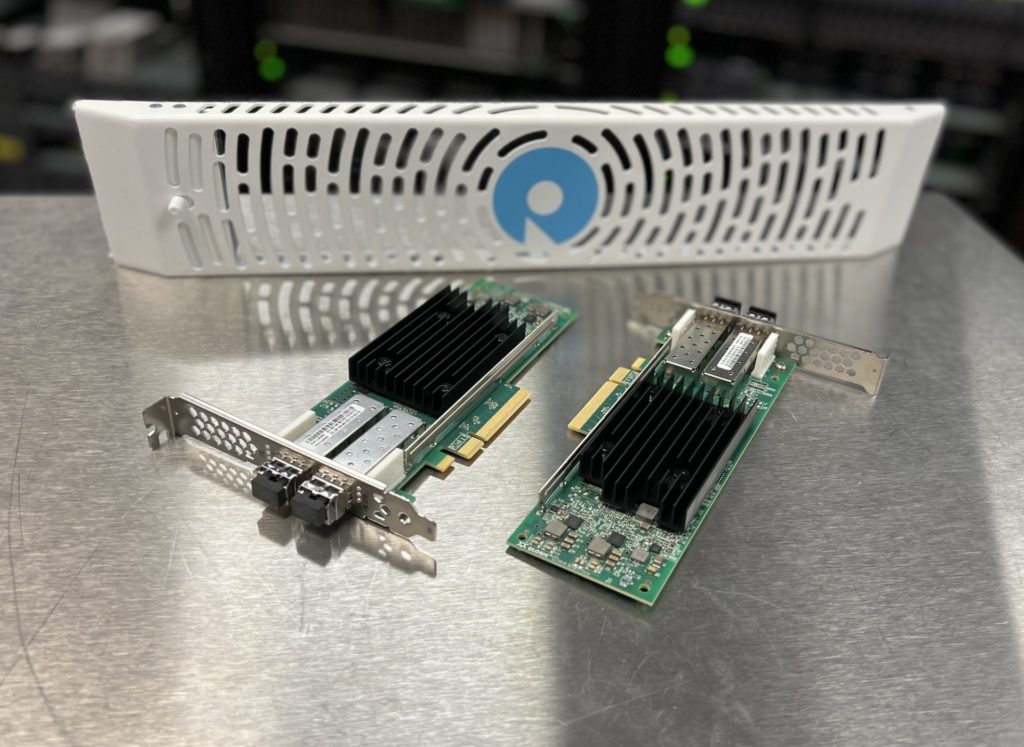
Since its inception, Marvell’s focus has been infrastructure networking, by building products that meet the service levels demanded by a variety of applications and various workloads. IT architects need to look for intelligent technology that provides flexibility and scalability to support SSD, Flash, sizable databases, and virtualization. Marvell firmly believes Fibre Channel (FC) is the go-to technology for storage transport, with an FC migration strategy for NVMe-oF via FC (FC-NVMe) with support for native VMware vSphere and ESXi. This technology is available today but not apparent to many customers.
NVMe-oF Primer
Marvell believes FC will remain the gold standard for storage networks primarily because FC has a history of reliability and innovation; it is enhancing the value of FC by focusing on including NVMe-oF technology for Fibre Channel to deliver additional value for the enterprise. Marvell has kept innovation at the fore for its deep product portfolio that supports EBOF, FC-NVMe, DPU, SSD controllers, and NVMe-oF. With such a deep product lineup, and their interest in networking technologies, Marvell has invited us into their lab to do some performance testing focused on FC-NVMe, NVMe/TCP, NVMe-RoCEv2 within a VMware ESXi environment.
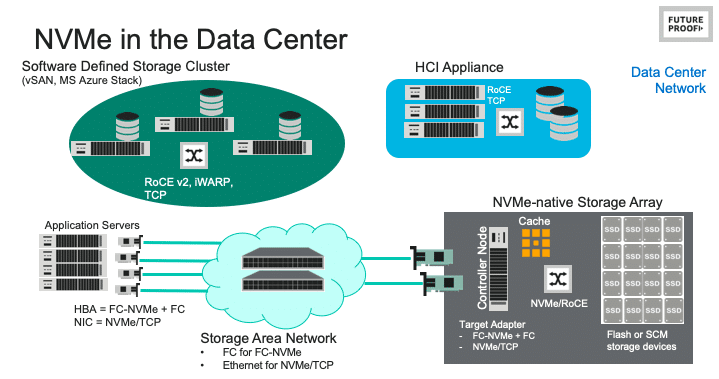
As vendors continue to roll out storage based on NVMe protocol, enterprises are fully embracing the technology. NVMe Flash arrays are deployed globally in many datacenters using Fibre Channel as the preferred transport because it is a proven technology for reliability, performance, and security. NVMe-oF has grown in popularity, with the NVMe workgroup rolling the standard into the NVMe 2.0 specification announced at the end of 2021.
As NVMe-oF standards have matured, vendors are incorporating the technology into storage and transport hardware, thereby easing deployment concerns. NVMe over Ethernet protocols will be used in Software-defined and HCI appliances as they typically connect to Ethernet networks. In the SAN, organizations using Fibre Channel today will transition to FC-NVMe, while those using iSCSI will likely transition to NVMe/TCP.
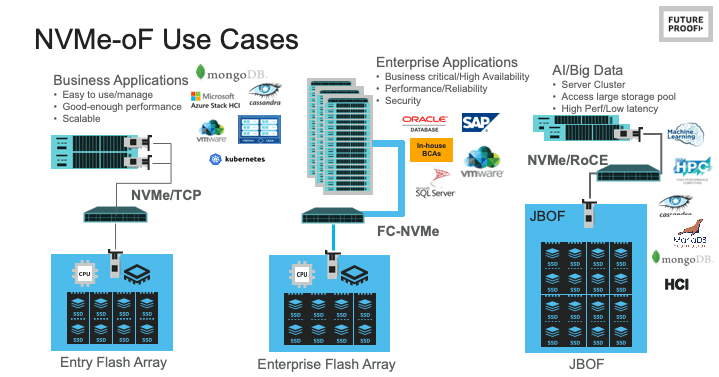
For decades, FC has been the go-to technology for mission- and business-critical environments because the design meets the performance and latency demands of block storage workloads. FC supports meeting the tight SLA for mission and business-critical workloads that are extremely sensitive to the performance and availability of underlying storage infrastructure. Workloads have increased in size, and that has affected infrastructure scalability. Of course, one of the primary focal points as these workloads grow is access to storage systems. NVMe over Fibre Channel provides numerous performance, latency, and reliability benefits. Sustained and predictable storage performance requires seamless integration and compatibility with Fibre Channel.
Other options for building out an IT infrastructure fabric include Ethernet and Infiniband. However, Fibre Channel’s inherent capabilities can best address the next-generation infrastructure performance, and scalability demands to meet NVMe metrics. Remember that Fibre Channel fabrics have been well established since the ANSI standard was published in 1994 and have continued to evolve, making the case that Fibre Channel is still the premier network technology for storage networks. And NVMe over FC can simultaneously support both NVMe and SCSI on the same network.


