



NLP is an artificial intelligence area that aids computers in understanding, interpreting, and manipulating human language. NLP draws on a range of sciences, including computer science and computational linguistics, to bridge the gap between human communication and machine understanding.
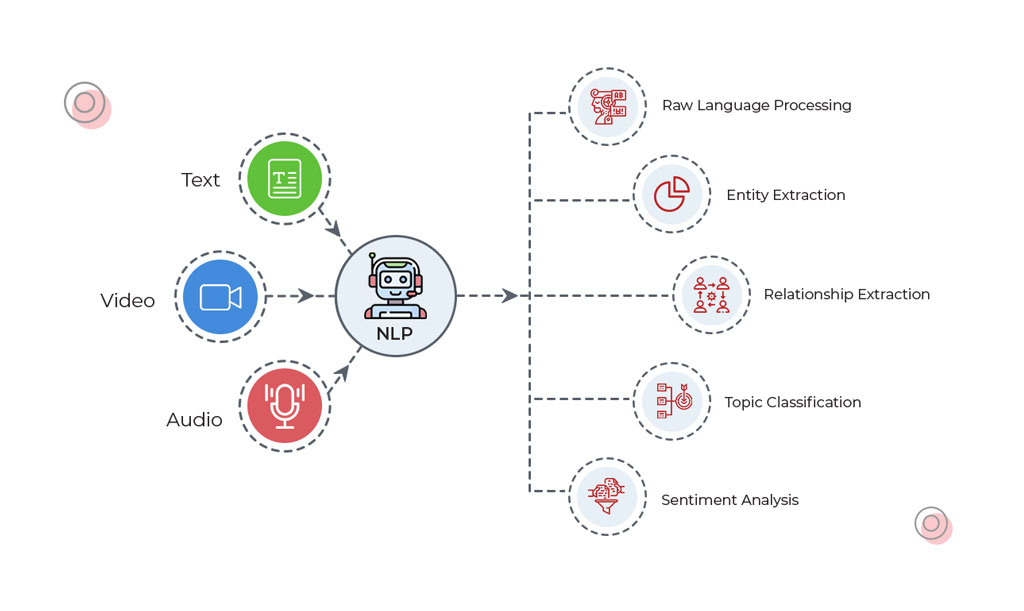
Developers can use Natural language processing to do tasks such as translation, automatic summarization, and relationship extraction, as well as audio recognition, named entity recognition, topic segmentation, and sentiment analysis.
What is Natural Language Processing?
Natural language processing tries to construct machines that comprehend and respond to text or voice input in the same way as humans do, and then respond with their own text or speech.
Computational linguistics, rule-based human language modelling is combined with statistical, machine learning, and deep learning models in NLP. When these technologies are combined, computers are able to process human language in the form of text or audio data and ‘understand’ the whole meaning of the language, including the speaker’s or writer’s intent and sentiment.
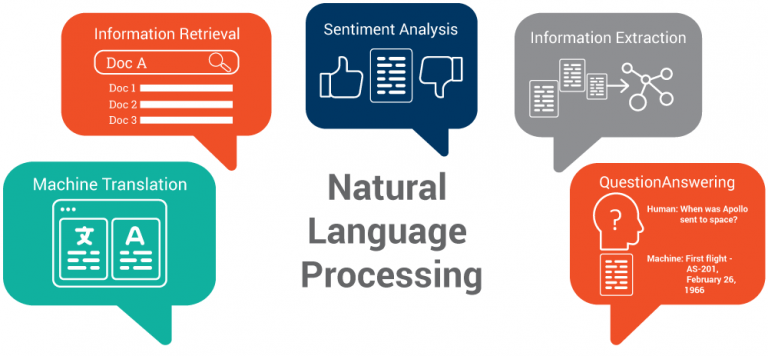
NLP is used to power computer programs that translate text from one language to another, respond to spoken commands, and quickly summarise vast amounts of material even in real-time. NLP is used in voice-activated GPS systems, digital assistants, speech-to-text dictation software, customer service chatbots, and other consumer conveniences. However, NLP is increasingly being used in corporate solutions to help businesses streamline operations, boost employee productivity, and simplify mission-critical business processes.
Evolution of Natural Language Processing
Natural language processing isn’t a new field, but it’s rising in popularity as a result of increased interest in human-machine communication, as well as the availability of large amounts of data, powerful computing, and improved algorithms.
As a person, you can communicate in English, Spanish, or Chinese. Machine code, often known as machine language, is a computer’s natural language that is virtually incomprehensible to most people. At its most fundamental level, your device interacts with millions of zeros and ones that make logical actions, rather than with words.
Indeed, 70 years ago, programmers spoke with the earliest computers using punch cards. Only a tiny number of people were aware of this time-consuming and manual method. “Alexa, I like this song” you may now say, and a device playing music in your house will reduce the volume and respond, “Ok”, “Rating saved,” a human-sounding voice said. Then, the next time you listen to that music station, it modifies its algorithm to play that song and others similar to it.
Let’s look at the interaction in more detail. In the span of around five seconds, your device triggered when it heard you speak, recognized the implicit intent in the comment, performed an action, and offered feedback in a well-formed English sentence. NLP, coupled with other AI features like machine learning and deep learning, enabled the entire interaction.
Why is NLP important?
While supervised and unsupervised learning, as well as deep learning, are now commonly employed to mimic human language, syntactic and semantic information, as well as domain expertise, are still required, which current machine learning algorithms do not always supply. NLP is significant because it helps resolve linguistic ambiguity and gives helpful quantitative structure to data for many downstream applications, such as speech recognition and text analytics.
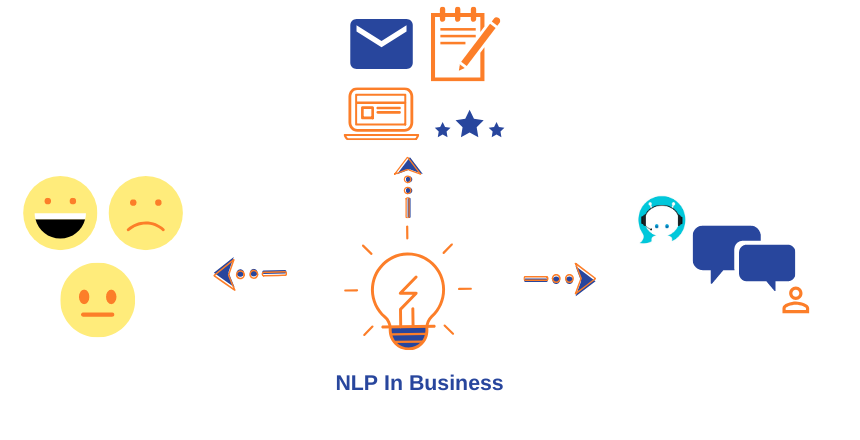
- Structuring a highly unstructured data source: The complexity and diversity of human language is remarkable. We can communicate in a variety of ways, both verbally and in writing. There are hundreds of languages and dialects, each with its own grammar, syntax, terminology, and slang. We frequently misspell, truncate, or omit punctuation when writing. We have regional accents, mumble, stutter, and borrow terminology from other languages when we talk.
- Large volumes of textual data: Natural language processing enables computers to converse with humans in their native tongue and scales other language-related activities. NLP allows computers to read text, hear a voice, analyze it, gauge sentiment, and identify which bits are significant. Machines can now interpret more language-based data than humans can, without becoming fatigued and in a consistent and unbiased manner. Given the massive volume of unstructured data generated every day, from medical records to social media, automation will be essential for efficiently analyzing text and audio data.
How does NLP Work?
Basic NLP tasks include tokenization and parsing, lemmatization/stemming, part-of-speech tagging, language detection, and semantic link identification. NLP activities, in general, break down language into smaller, essential components, attempt to comprehend links between the pieces, and investigate how the pieces interact to form meaning.
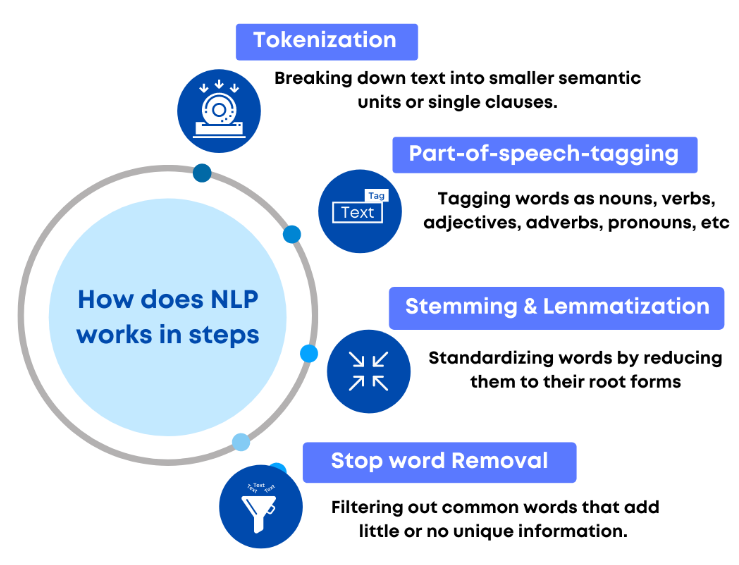
These tasks are frequently employed in higher-level NLP capabilities, such as:
- Lexical Analysis: The process of recognizing and examining the structure of words is known as lexical analysis. The collection of words and phrases in a language is referred to as the lexicon. Lexical analysis is the process of breaking down a large piece of text into paragraphs, phrases, and words.
- Syntactic Analysis (Parsing): t is the process of examining a phrase for grammar and arranging the words in a way that reveals their relationship. An English syntactic analyzer will reject a statement like “The school goes to the boy.”
- Semantic analysis: It extracts the text’s specific meaning or dictionary definition. The meaning of the text is examined. It is accomplished by mapping the task domain’s syntactic structures and objects. Sentences like “hot ice cream” are ignored by the semantic analyzer.
- Discourse Integration: The meaning of any sentence is determined by the meaning of the sentence immediately preceding it. It also establishes the meaning of a sentence that follows it.
- Pragmatic Analysis: Any sentence’s meaning is defined by the meaning of the sentence that comes before it. It also sets the meaning of the following statement.
Components of Natural Language Processing
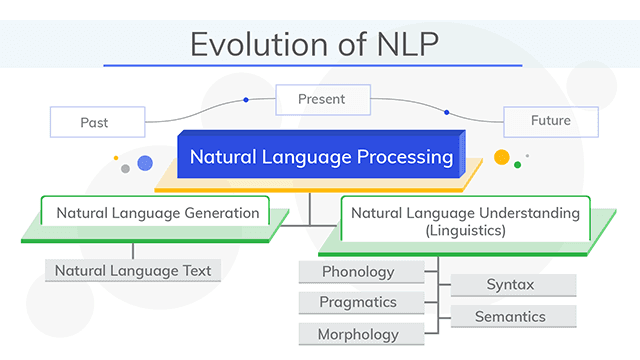
Basically, Natural Language Processing systems are made up of two main components:
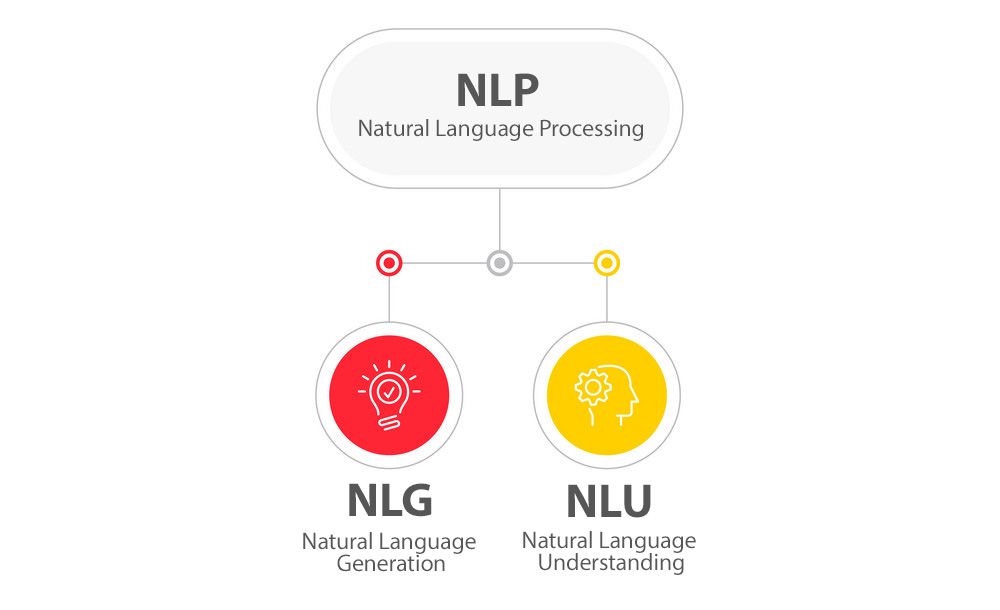
- Natural Language Understanding (NLU): It is a branch of natural language processing (NLP) that deals with converting human language into a machine-readable format. Computers can automatically interpret data in seconds using natural language understanding (NLU) and machine learning, saving organizations precious hours and money when reviewing troves of client feedback.
- Natural Language Generation (NLG): NLG is a software technique that automatically turns data into plain-English content. It’s an artificial intelligence subfield (AI). NLG is one of the most rapidly gaining traction in the business world. NLG has a wide range of applications, but it is most effective when used to automate time-consuming data analysis and reporting tasks.
Natural Language Processing Tools and Approaches
Python and the Natural Language Toolkit (NLTK): For tackling certain NLP tasks, the Python programming language provides a good choice of tools and packages. Many of them may be found in the tongue Toolkit, or NLTK, an open-source collection of libraries, applications, and educational resources for creating natural language processing programs.
Statistical NLP, machine learning, and deep learning: Statistical Natural Language Processing uses a combination of computer algorithms, machine learning, and deep learning models to automatically extract, classify, and label elements of text and voice data, then assigns a statistical likelihood to each of these elements’ possible meanings. Deep learning models and learning approaches enabled by CNNs and RNNs now allow NLP systems to ‘learn’ as they go, extracting ever more accurate meaning from massive volumes of unstructured, unlabeled text and voice input.
Natural Language Processing libraries
- NLTK (Natural Language Toolkit): The NLTK Python framework is mostly used for teaching and research. It’s not commonly utilized in production environments. However, because of its simplicity, it may be utilized to create fascinating programs.
- spaCy: spaCy is a fast and production-ready open-source Python library for natural language processing. spaCy focuses on providing production-ready software.
- Gensim: Gensim is a Python-based natural language processing toolkit for topic modeling and similarity identification. It’s not a general-purpose NLP library, but it excels at the jobs it’s given.
- Pattern: Pattern is a Python NLP framework with a simple syntax. It’s a versatile tool that can be used for both scientific and non-scientific applications. It is really beneficial to students.
- TextBlob: TextBlob is a Python package for textual data processing.
Exploring Features of NLTK
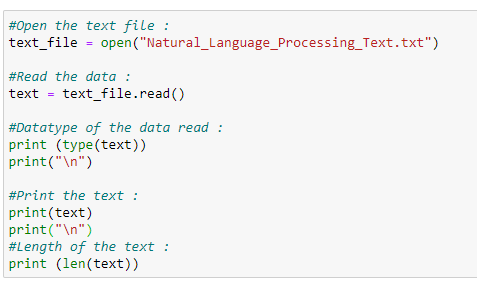
Open the text file for processing:
We’ll begin by opening and reading the file we’ll be analyzing.
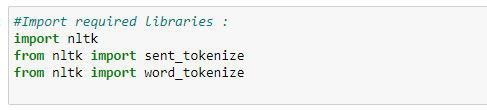
Import Required Libraries:
We need to load some libraries for various data processing situations in NLP. We will utilize NLTK for Natural Language Processing in this scenario. We’ll use it to manipulate the text in a variety of ways.
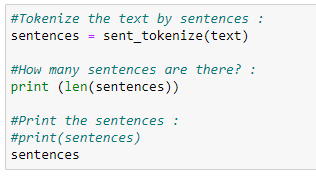
Sentence tokenizing:
We may turn the text into sentences by using sent tokenize() to tokenize it.
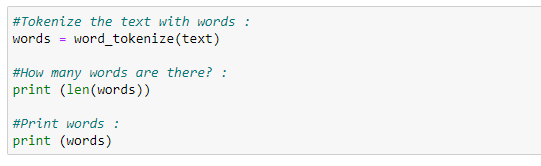
Word tokenizing:
We may get the text as words by tokenizing it using word tokenize().
Find the frequency distribution:
Let’s see how many times each word appears in our text.
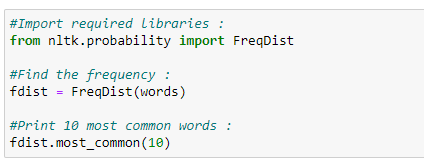
Punctuation marks and stopwords are the most often used words. To examine the actual content, we’ll have to eliminate such words.
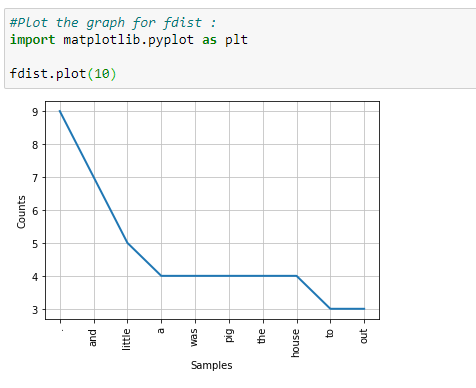
Plot the frequency graph:
Plot a graph to view the word distribution in our text: Let’s plot a graph to visualize the word distribution in our text.
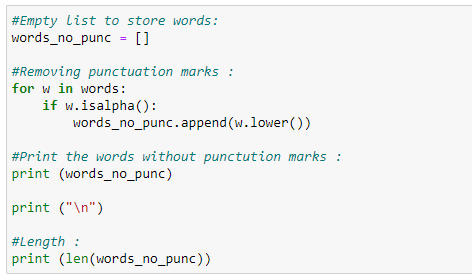
Remove punctuation marks:
We’ll remove the punctuation marks next because they’re not particularly useful. To distinguish the punctuation marks from the actual text, we’ll utilize the isalpha() technique. We’ll also create a separate list named words no punc, which will store words in lower case but not include punctuation marks.
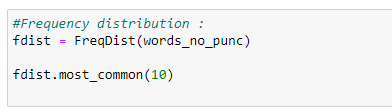
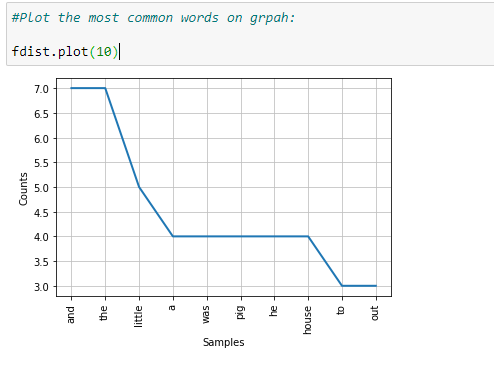
Plotting graph without punctuation marks:
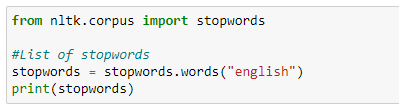
List of stopwords:
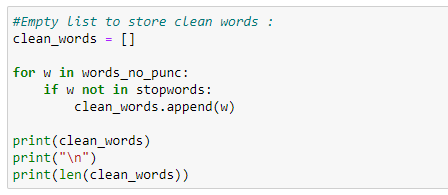
Removing stopwords:
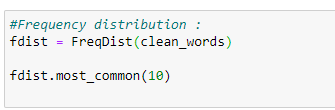
Final frequency distribution:
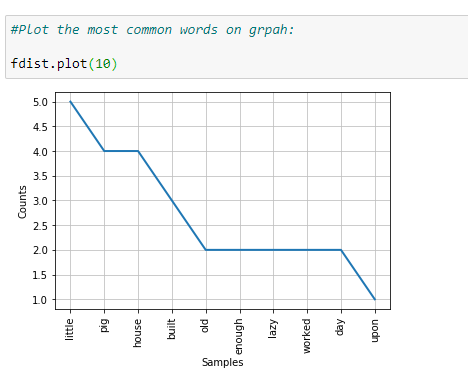
The finished graph, as seen above, contains many valuable phrases that assist us to comprehend what our sample data is about, demonstrating the importance of NLP data cleaning.
Sample Python Code
NLTK is a standard Python package with prebuilt functions and utilities for quick and easy use. It is one of the most widely used libraries for computational linguistics and natural language processing. We’ll begin by importing some relevant Python libraries.
Running the NLP Script
import nltk
from nltk.tokenize import sent_tokenize
from nltk.tokenize import word_tokenize
from nltk.tokenize import WordPuncttokenizer
from nltk.stem.porter import PorterStemmer
from nltk.stem.lancaster import LancasterStemmer
from nltk.stem.snowball import SnowballStemmer
from nltk.stem import WordNetLemmatizer
sentence =[("a","DT"),("clever","JJ"),("fox","NN"),("was","VBP"),
("jumping","VBP"),("over","IN"),("the","DT"),("wall","NN")]
Grammar should be given in the form of regular expression as follows
grammar = "NP:{?*}"Define a parser for parsing the grammar.
parser_chunking = nltk.RegexpParser(grammar)
The parser will parse the sentence
parser_chunking.parse(sentence)
The output will be in the variable as follows
Output = parser_chunking.parse(sentence)
Code will help you draw your output in the form of a tree.
output.draw()
Conclusion
Learning natural language processing is beneficial if you are interested in engaging with computing systems and have programming and linguistic knowledge. The demand for natural language processing is expanding day by day as a result of a growth in data and the need to interface with computers, and a variety of career opportunities with attractive pay packages are emerging. As a result, NLP has a bright future ahead of it.
Key Takeaways:
- NLP is an artificial intelligence area that aids computers in understanding, interpreting, and manipulating human language.
- NLP tries to construct machines that comprehend and respond to text or voice input in the same way as humans do.
- NLP is significant because it helps resolve linguistic ambiguity and gives helpful quantitative structure to data for many downstream applications, such as speech recognition and text analytics.
- Machines can now interpret more language-based data than humans can, without becoming fatigued and in a consistent and unbiased manner.
- Basic NLP tasks include tokenization and parsing, lemmatization/stemming, part-of-speech tagging, language detection, and semantic link identification.
- NLTK Python framework is mostly used for teaching and research.


