

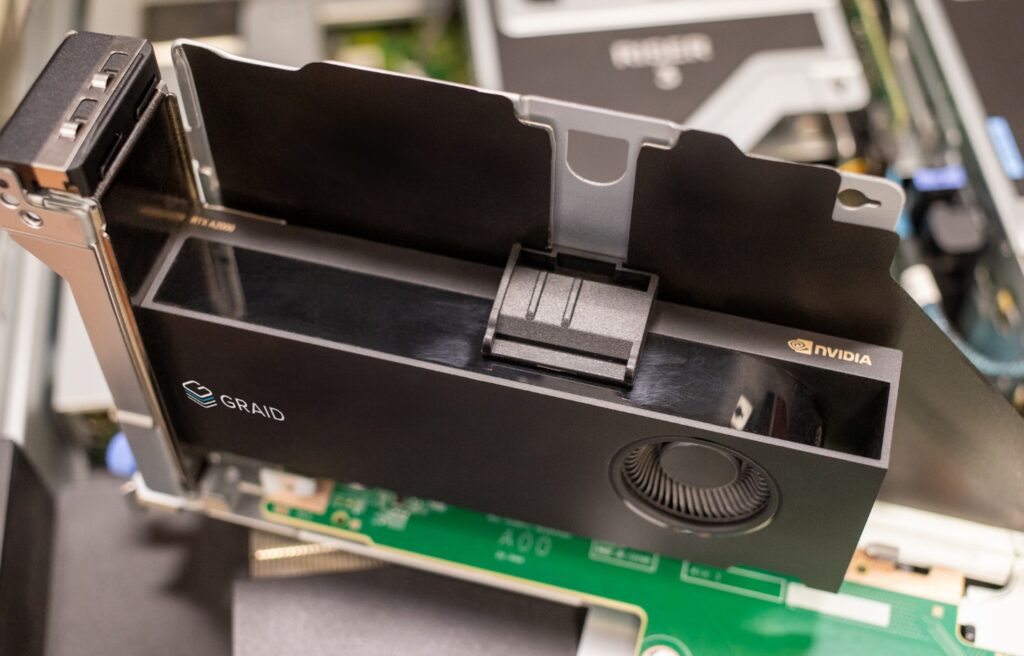
The newer Gen4 card offers increased computation power and PCIe bandwidth. The PCIe bandwidth contributes to write performance since write data flows through the GPU card. This is where sequential write and random write performance double because of the bandwidth increase from 10GB/s to 20GB/s (PCIe Gen3 vs Gen4).
A more complete spec overview is below, and the detailed sheet from GRAID is here.
- Supported RAID Levels – RAID 0, 1, 5, 6, 10
- Max Physical Drives – 32
- Max Drive Groups – 4
- Max Virtual Drives per Drive Group- 8
- Max Drive Group Size –
- Defined by physical drive size
- OS Support
- Linux: Alma Linux 8.5
- Rocky Linux 8.5
- CentOS 7.9, 8.4, 8.5
- openSUSE Leap 15.2, 15.3
- RHEL 7.9, 8.4, 8.5
- SLES 15 SP2, SP3
- Ubuntu 20.04
- Windows Server 2019 x86-64
- Windows Server 2022 x86-64
- Host Interface – x16 PCIe Gen 4.0
- Max Power Consumption – 70W
- Form Factor – 2.713″ H x 6.6″ L, Single Slot
- Product Weight – 306 g

GRAID SupremeRAID SR-1010 Performance
To measure the performance of the SupremeRAID SR-1010, we leveraged our Dell PowerEdge R750 running Ubuntu 20.04 with eight Gen4 NVMe bays in front. We leveraged eight of the Memblaze PBlaze6 6926 12.8TB SSD, giving us a large footprint of high-performance NAND to use in a RAID5 configuration.
Since these are different SSDs than our last review, we completed a full round of new tests comparing RAID5 configurations using software RAID versus the SR-1000 and SR-1010. For Software RAID we leveraged mdadm with a 64K chunk size. Tests were performed running FIO against the RAID volume.
Dell PowerEdge R750 Specifications:
- 2 x 8380 Intel 3rd Gen Intel Xeon Scalable CPUs
- 32 x 32GB DDR4 3200MHz
- 8 x 12.8TB Memblaze PBlaze6 6926
| RAID 5 FIO Performance | ||||
| Test | SW RAID5 | SR-1000 (Gen3) | SR-1010 (Gen4) | |
| 1MB sequential write (16T/32Q) | 1.3GB/s | 11.1GB/s | 17.7GB/s | |
| 1MB sequential read (16T/32Q) | 56.2GB/s | 49.4GB/s | 49.4GB/s | |
| 8K random 70/30 (32T/64Q) | 160.2k IOPS | 1.51M IOPS | 1.95M IOPS | |
| 4K random write (32T/64Q) | 73.9k IOPS | 838k IOPS | 1.56M IOPS | |
| 4K random read (32T/64Q) | 2.24M IOPS | 10.3M IOPS | 11.0M IOPS | |