

• Latest
  • Trending
Solve a Real-world Problem Using Classical Machine Learning

Solve a Real-world Problem Using Classical Machine Learning

March 29, 2022
Absa and Visa Extend Strategic Partnership to Advance Growth and Innovation Across Africa

Absa and Visa Extend Strategic Partnership to Advance Growth and Innovation Across Africa

July 29, 2025
French Telco Orange Hit by Cyber-Attack

French Telco Orange Hit by Cyber-Attack

July 29, 2025
ATC Ghana supports Girls-In-ICT Program

ATC Ghana supports Girls-In-ICT Program

April 25, 2023
Vice President Dr. Bawumia inaugurates  ICT Hub

Vice President Dr. Bawumia inaugurates ICT Hub

April 2, 2023
Co-Creation Hub’s edtech accelerator puts $15M towards African startups

Co-Creation Hub’s edtech accelerator puts $15M towards African startups

February 20, 2023
Data Leak Hits Thousands of NHS Workers

Data Leak Hits Thousands of NHS Workers

February 20, 2023
EU Cybersecurity Agency Warns Against Chinese APTs

EU Cybersecurity Agency Warns Against Chinese APTs

February 20, 2023
How Your Storage System Will Still Be Viable in 5 Years’ Time?

How Your Storage System Will Still Be Viable in 5 Years’ Time?

February 20, 2023
The Broken Promises From Cybersecurity Vendors

Cloud Infrastructure Used By WIP26 For Espionage Attacks on Telcos

February 20, 2023
Instagram and Facebook to get paid-for verification

Instagram and Facebook to get paid-for verification

February 20, 2023
YouTube CEO Susan Wojcicki steps down after nine years

YouTube CEO Susan Wojcicki steps down after nine years

February 20, 2023
Inaugural AfCFTA Conference on Women and Youth in Trade

Inaugural AfCFTA Conference on Women and Youth in Trade

September 6, 2022
  • Consumer Watch
  • Kids Page
  • Directory
  • Events
  • Reviews
Friday, 17 July, 2026
  • Login
itechnewsonline.com
  • Home
  • Tech
  • Africa Tech
  • InfoSEC
  • Data Science
  • Data Storage
  • Business
  • Opinion
Subscription
Advertise
No Result
View All Result
itechnewsonline.com
No Result
View All Result

Solve a Real-world Problem Using Classical Machine Learning

by ITECHNEWS
March 29, 2022
in Data Science, Leading Stories
0 0
0
Solve a Real-world Problem Using Classical Machine Learning

Introduction

Any company in existence today thrives to make a profit. Insurance companies are profitable when the claims that they issue are lesser than the premiums they receive.

This is the real-world problem we are going to tackle today. If there is a method by which the insurance company can predict a person’s hospital bills, they would be able to generate a financial gain.

YOU MAY ALSO LIKE

French Telco Orange Hit by Cyber-Attack

ATC Ghana supports Girls-In-ICT Program

This article aims to provide a good starter for someone who wants to solve a real-world problem using classical machine learning.

We have data of about 1338 observations(rows) and 7 features(columns) including age, gender, BMI(Body Mass Index), number of children they have, the region they belong to, and if they are a smoker or a non-smoker. Our task is to uncover a relationship that might exist between a person’s hospital bills and their family conditions, health factors, or location of residence.

With this introduction, we start exploring the data. Remember that garbage in is garbage out. You could use the best possible machine learning model but if your data is garbage your results would not be good as well. This makes it imperative to have a thorough data analysis. Let’s begin.

Data Exploration in Machine Learning
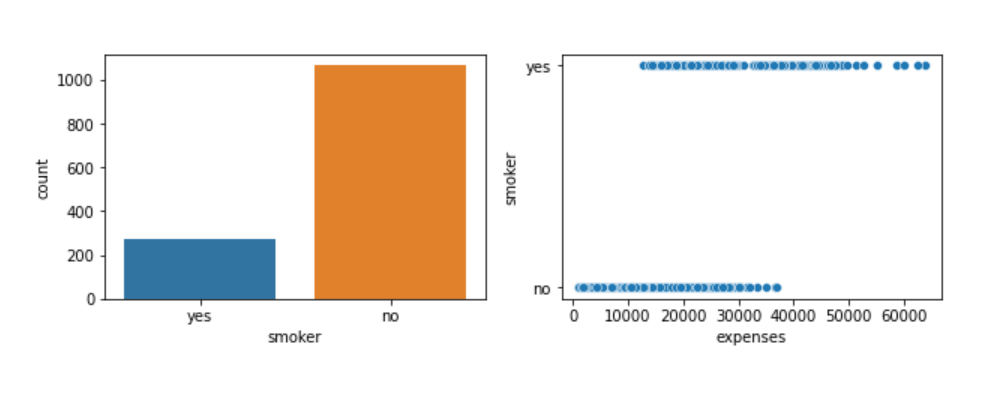
Data Exploration From the count plot on the left, we know that the data has more non-smokers than smokers. Even then from the plot on the right, it is evident that the hospital bills of a smoker are higher than those of non-smokers. We can certainly see a pattern between the feature ‘smoker’ and our target ‘hospital bills’.
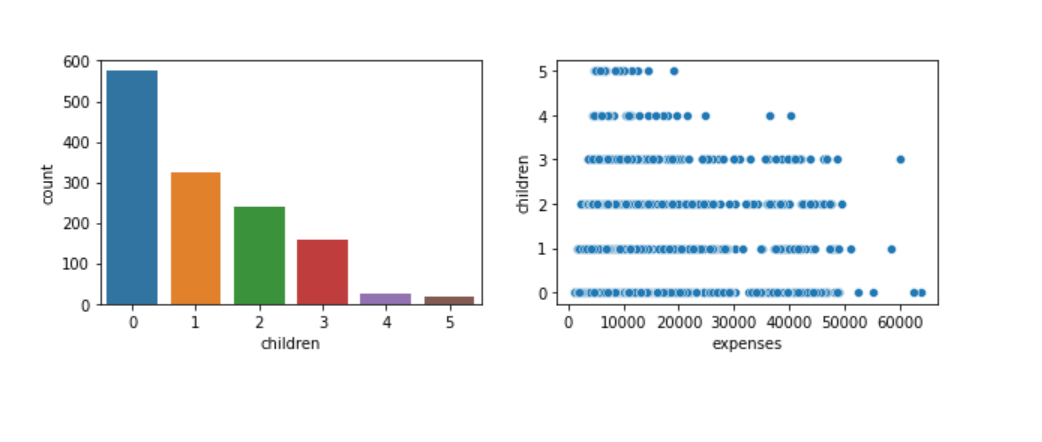
Let’s look at the next feature, children (which gives us the number of children a person has)
Data Exploration Image 1
What I thought before plotting the above graphs was an increase in hospital bills with an increasing number of children, but our data do not abide by my initial belief. As you can see from the scatter plot on the right, there are some instances when observations with 0 children have more bills than observations with 5 children. Our data is also imbalanced with respect to the feature ’children’, from the count plot on the left we observe that we have the most observations with people having 0 children and the least with 5 children.
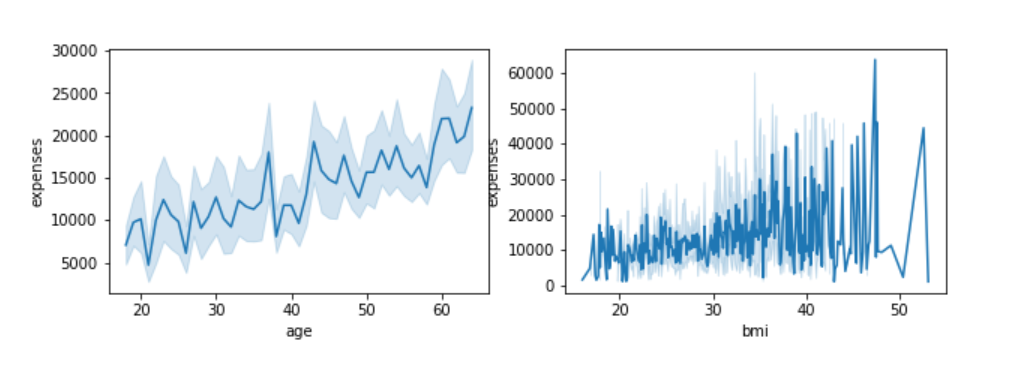
Moving on to further visualize features ‘Age’ and ‘BMI’.
Machine Learning problems
The graph on the left establishes the trend of direct proportionality between age and bills, with an increase in age we can see in most cases an increase in bills.
BMI and expenses line graph on the right does not represent any pattern as we can see some instances of higher BMI with lower expenses, what we can establish for feature BMI is the lowest value in our data is 15 and the highest is up to 60.

The last feature we need to look into is ‘gender’.
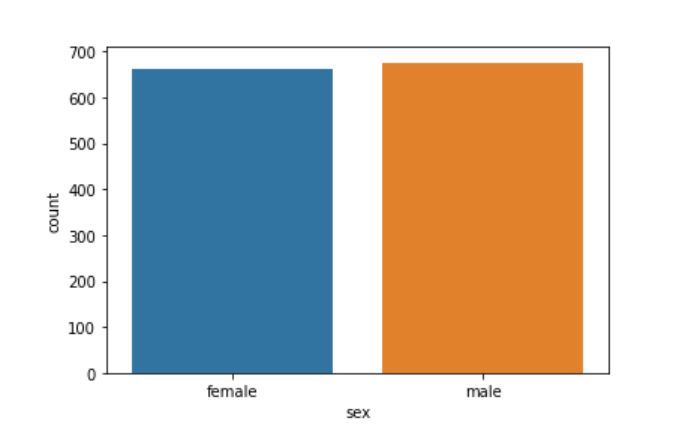
Data Exploration Image 2 | Machine Learning problems
The count plot above shows that we have a good balance in the data as far as gender is concerned. We have an almost equal number of males and females.
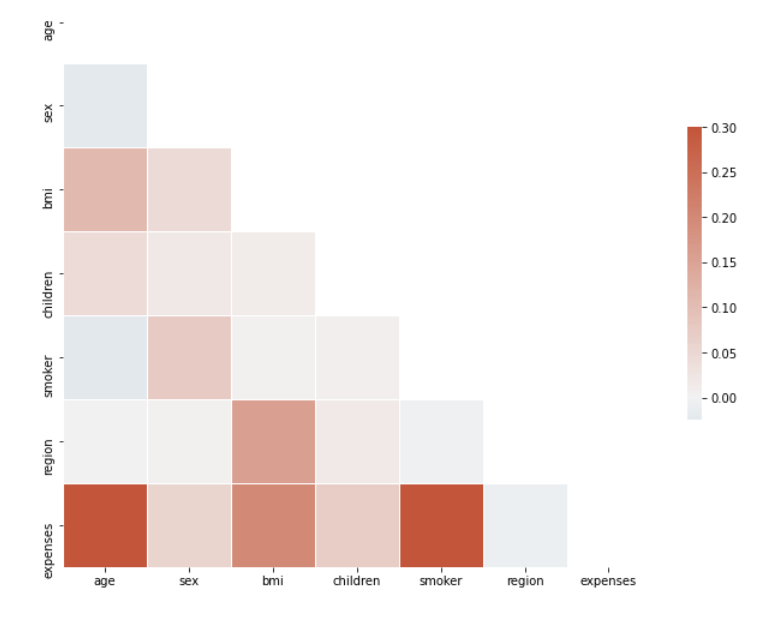
For further understanding of the impact of the input features (Age, BMI, region, gender, smoker) on the target variable expenses, we plot a correlation matrix.
Data Exploration Image 4
From the correlation matrix above, we establish the following:
The highest correlation can be observed between expenses and age followed by smokers and expenses; BMI and expenses display a good correlation too. Let us further use these to see how they perform to predict hospital bills.

Data Preprocessing in Machine Learning

Before feeding data into the model we would need to do certain checks in other words preprocess the data.
1. Handling missing data (Reference:- https://towardsdatascience.com/7-ways-to-handle-missing-values-in-machine-learning-1a6326adf79e)
The dataset we are working with currently does not have any missing data which is why we do not need to perform this step.
2. Encoding categorical data.
Machine learning models can only work with numerical data, which is why we need to logically encode the categorical features in our dataset to numeric values. There are many ways to perform encoding I am using LabelEncoder from the sklearn library for this case study.
from sklearn.preprocessing import LabelEncoder
label = LabelEncoder()
df.iloc[:,1] = label.fit_transform(df.iloc[:,1])
df.iloc[:,5] = label.fit_transform(df.iloc[:,5])
df.iloc[:,4] = label.fit_transform(df.iloc[:,4])

Above is a code snippet displaying the use of LabelEncoder for encoding categorical features region, smoker, and sex. At the end of this article, I would also link my entire notebook for your reference.

Fitting a Model and Making Predictions

Machine learning involves a lot of experimentation, I tried using a combination of different features and I found that the gender and region features were not contributing much to the target(expense) variable. Considering the same we divide our data frame into X and Y as below.

X = df[['bmi','age','smoker','children']]
Y = df['expenses']
Using sklearn’s inbuilt function train_test_split we divide the data into training and validation data.
Why do we need to divide data into training and validation?
The short answer is to avoid overfitting and to evaluate your model correctly. For a detailed explanation, I suggest you to refer (https://machinelearningmastery.com/train-test-split-for-evaluating-machine-learning-algorithms/)
X_train,X_test,y_train,y_test = sklearn.<a onclick="parent.postMessage({'referent':'.sklearn.model_selection'}, '*')">model_selection.train_test_split(X,Y,test_size=0.25)

Our problem is a regression problem as we are trying to predict expense which is a real-valued number. We would use DecisionTreeRegressor and LinearRegression models for the above task.

from sklearn.tree import DecisionTreeRegressor
from sklearn.model_selection import cross_val_score
regressor = DecisionTreeRegressor(random_state=0)
#cross_val_score(regressor, X_train, y_train, cv=10)
regressor.fit(X_train, y_train)
y_predict = regressor.predict(X_test)
mse_dt = mean_squared_error(y_test,y_predict,squared=False)
print(mse_dt)
6900.60117589873
from sklearn.linear_model import LinearRegression
regressor = LinearRegression()
#cross_val_score(regressor, X_train, y_train, cv=10)
regressor.fit(X_train, y_train)
y_predict = regressor.predict(X_test)
mse_dt = mean_squared_error(y_test,y_predict,squared=False)
print(mse_dt)
5908.41334052373
We get a lower mean squared error with Linear Regression than the Decision tree regressor. We can further lower the MSE(mean squared error) or improve the model performance by using hyperparameter tuning methodologies like Grid Search and Random Search.
Deploying a model. After you are satisfied with your model’s performance you would have to deploy the model such that the intended users can use the functionality.
We would today look at the gradio library that lets us build a web application using just a few lines of code.
!pip install gradio
import gradio as gr

def greet(<a onclick="parent.postMessage({'referent':'.kaggle.usercode.19256245.71583406.greet..bmi'}, '*')">bmi,<a onclick="parent.postMessage({'referent':'.kaggle.usercode.19256245.71583406.greet..age'}, '*')">age,<a onclick="parent.postMessage({'referent':'.kaggle.usercode.19256245.71583406.greet..smoker'}, '*')">smoker,<a onclick="parent.postMessage({'referent':'.kaggle.usercode.19256245.71583406.greet..children'}, '*')">children):
    if <a onclick="parent.postMessage({'referent':'.kaggle.usercode.19256245.71583406.greet..smoker'}, '*')">smoker:
        <a onclick="parent.postMessage({'referent':'.kaggle.usercode.19256245.71583406.greet..is_smoker'}, '*')">is_smoker = 1
    else: 
        <a onclick="parent.postMessage({'referent':'.kaggle.usercode.19256245.71583406.greet..is_smoker'}, '*')">is_smoker = 0
    <a onclick="parent.postMessage({'referent':'.kaggle.usercode.19256245.71583406.greet..X_test'}, '*')">X_test = pd.<a onclick="parent.postMessage({'referent':'.pandas.DataFrame'}, '*')">DataFrame.from_dict({'bmi':[<a onclick="parent.postMessage({'referent':'.kaggle.usercode.19256245.71583406.greet..bmi'}, '*')">bmi],'age':[<a onclick="parent.postMessage({'referent':'.kaggle.usercode.19256245.71583406.greet..age'}, '*')">age],'smoker':[<a onclick="parent.postMessage({'referent':'.kaggle.usercode.19256245.71583406.greet..is_smoker'}, '*')">is_smoker],'children':[<a onclick="parent.postMessage({'referent':'.kaggle.usercode.19256245.71583406.greet..children'}, '*')">children]}) 
    print(<a onclick="parent.postMessage({'referent':'.kaggle.usercode.19256245.71583406.greet..X_test'}, '*')">X_test)
    <a onclick="parent.postMessage({'referent':'.kaggle.usercode.19256245.71583406.greet..y_predict'}, '*')">y_predict = regressor.predict(<a onclick="parent.postMessage({'referent':'.kaggle.usercode.19256245.71583406.greet..X_test'}, '*')">X_test)
    print(<a onclick="parent.postMessage({'referent':'.kaggle.usercode.19256245.71583406.greet..y_predict'}, '*')">y_predict)
    return <a onclick="parent.postMessage({'referent':'.kaggle.usercode.19256245.71583406.greet..y_predict'}, '*')">y_predict[0]     

iface = gr.<a onclick="parent.postMessage({'referent':'.gradio.Interface'}, '*')">Interface(
  fn=greet, 
  inputs=['text','text','checkbox','text'], 
  outputs="number")
iface.launch(share=True)
What we have done in the above code is created a function that takes input from the feature entered by the user and predicts an amount for your hospital expense.
Through gradio, we create an interface that passes the input from the webpage to the function for prediction and displays the function’s predicted output on the webpage. I would recommend you to read the official documentation of gradio before getting started with it (https://gradio.app)

As promised, link to my code.

Conclusion

The key takeaways from the above article are as follow:

1) A simpler model like Linear Regression can perform better than Decision trees for some datasets.

2) Being a smoker or having more number of children increases the possibility of hospital expenses.

Source: Alifia Ghantiwala
Via: analyticsvidhya
Tags: Solve a Real-world Problem Using Classical Machine Learning
ShareTweet

Get real time update about this post categories directly on your device, subscribe now.

Unsubscribe

Search

No Result
View All Result

Recent News

Absa and Visa Extend Strategic Partnership to Advance Growth and Innovation Across Africa

Absa and Visa Extend Strategic Partnership to Advance Growth and Innovation Across Africa

July 29, 2025
French Telco Orange Hit by Cyber-Attack

French Telco Orange Hit by Cyber-Attack

July 29, 2025
ATC Ghana supports Girls-In-ICT Program

ATC Ghana supports Girls-In-ICT Program

April 25, 2023

About What We Do

itechnewsonline.com

We bring you the best Premium Tech News.

Recent News With Image

Absa and Visa Extend Strategic Partnership to Advance Growth and Innovation Across Africa

Absa and Visa Extend Strategic Partnership to Advance Growth and Innovation Across Africa

July 29, 2025
French Telco Orange Hit by Cyber-Attack

French Telco Orange Hit by Cyber-Attack

July 29, 2025

Recent News

  • Absa and Visa Extend Strategic Partnership to Advance Growth and Innovation Across Africa July 29, 2025
  • French Telco Orange Hit by Cyber-Attack July 29, 2025
  • ATC Ghana supports Girls-In-ICT Program April 25, 2023
  • Vice President Dr. Bawumia inaugurates ICT Hub April 2, 2023
  • Home
  • InfoSec
  • Opinion
  • Africa Tech
  • Data Storage

© Copyright 2026, All Rights Reserved | iTechNewsOnline.Com - Powered by BackUPDataSystems

Welcome Back!

Login to your account below

Forgotten Password?

Retrieve your password

Please enter your username or email address to reset your password.

Log In

Add New Playlist

No Result
View All Result
  • Home
  • Tech
  • Africa Tech
  • InfoSEC
  • Data Science
  • Data Storage
  • Business
  • Opinion

© Copyright 2026, All Rights Reserved | iTechNewsOnline.Com - Powered by BackUPDataSystems

Are you sure want to unlock this post?
Unlock left : 0
Are you sure want to cancel subscription?
Go to mobile version